Product overview
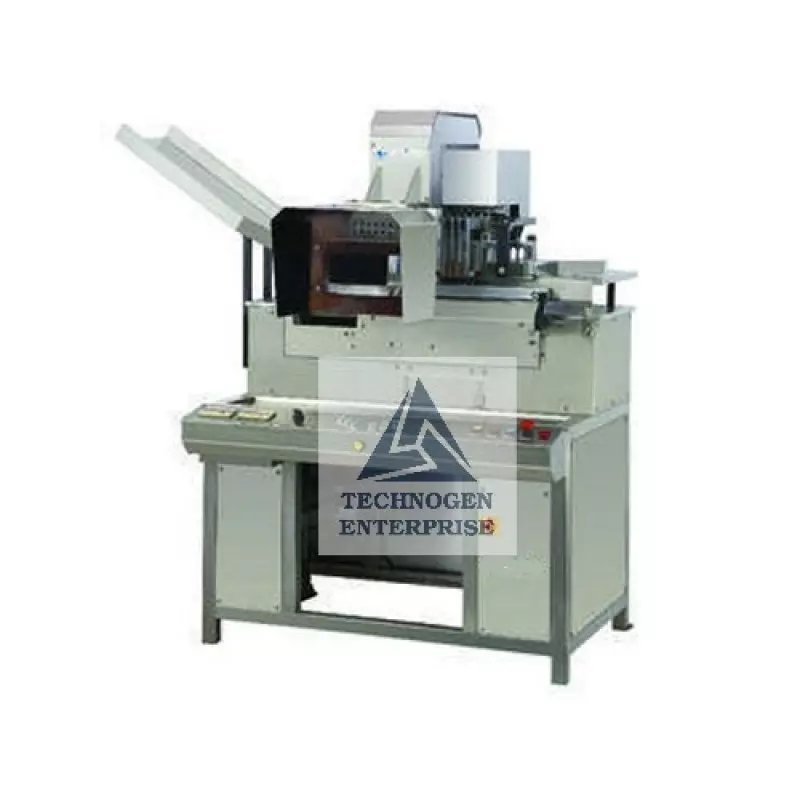
Visual inspection of injectable ampoules depends on two things working together: the liquid inside the ampoule must be put into controlled motion so that suspended contamination becomes visible, and the operator must have a clear, illuminated view of the container while making the acceptance or rejection decision.
The Ampoule Visual Inspection Machine is developed around this inspection principle.
Instead of merely transporting ampoules past an operator, the machine uses six dedicated spinning assemblies to rotate the containers at controlled speed. This creates a vortex within the liquid, helping visible foreign particles move into the viewing field where they can be identified more effectively.
Technogen Enterprise serves pharmaceutical and injectable manufacturing facilities as a Manufacturer and Supplier of Ampoule Visual Inspection Machine equipment for Tanzania, offering a semi-automatic inspection system for detecting visible defects such as glass pieces, dirt particles, filter-medium remnants, black particles and cracks in the ampoule body.
The machine operates at approximately 50 to 60 ampoules per minute, with actual inspection output influenced by operator competence, inspection time, ampoule quality and the number of repeat inspections required. At the upper operating rate, this corresponds to approximately 3,600 ampoules per hour.
A major feature of the machine is its viewing arrangement. Six ampoules can be observed simultaneously through a magnification system supported by backlit illumination. The main lens provides approximately 1.75X overall magnification, while a specific inspection area can be viewed at magnification up to 3X.
Two 18 W magnifying lamps, each providing approximately 1800 lumens, illuminate the inspection zone and help the operator observe particles, contamination and physical defects more clearly.
Ampoules are loaded and unloaded using a tray arrangement, keeping material handling straightforward while retaining semi-automatic movement through the inspection sequence.
Separate Variable Frequency Drives are provided for the main machine and the ampoule-spinning system. This allows bottle movement and spinning speed to be adjusted independently according to inspection requirements.
For pharmaceutical and injectable facilities in Tanzania, this machine provides a controlled visual-inspection station between production and final packaging, while preserving the human decision-making element required for visual defect assessment.
Working principle
Ampoules are loaded into the machine using trays and introduced into the inspection system.
A special reflex photoelectric sensor, mounted within the aluminium star-wheel arrangement, assists in separating and positioning the ampoules as they move through the machine.
The containers are then transferred to the inspection section containing six individual spinning assemblies.
Each ampoule is rotated at controlled speed. This high-speed spinning creates a vortex inside the liquid and puts suspended particles into motion.
Once spinning is completed, the ampoules enter the illuminated visual inspection area.
The operator views six ampoules simultaneously through the magnification lens against the backlit inspection arrangement.
Visible contamination or defects such as:
- Glass fragments
- Dirt particles
- Filter-medium remnants
- Black particles
- Cracks
can then be identified through visual examination.
The magnification system provides approximately 1.75X overall viewing magnification, with selected areas capable of being viewed up to approximately 3X magnification.
When a defective ampoule is identified, the operator uses the dedicated ejection switch to reject it.
A repeat-cycle arrangement allows ampoules to be inspected again where additional observation is necessary.
Two separate counters monitor production: one records the total inspected quantity, while the second records the rejected quantity.
Salient features
- CGMP Compact Design : Provides a space-efficient inspection platform for pharmaceutical production areas.
- SS 304 Construction : Stainless Steel construction supports hygiene, durability and easy cleaning.
- Tray Loading System : Simplifies loading and unloading of ampoules during inspection.
- Six Spinning Assemblies : Allows six ampoules to be processed simultaneously during the spinning stage.
- Adjustable Spinning Speed : Enables vortex intensity to be controlled according to inspection requirements.
- Independent VFD Control : Separate drives control main-machine movement and ampoule spinning independently.
- Reflex Photoelectric Sensor : Assists accurate ampoule separation and movement through the inspection section.
- Magnified Viewing System : Provides approximately 1.75X overall magnification for inspection.
- Local 3X Magnification : Allows closer viewing of a selected inspection area.
- Backlit Inspection Area : Improves visibility of particles and defects inside the ampoule.
- Dual 18 W Magnifying Lamps : Provides strong illumination for operator inspection.
- Operator Ejection Switch : Allows defective ampoules to be rejected immediately.
- Repeat Inspection Cycle : Allows questionable ampoules to pass through another inspection cycle.
- Total Production Counter : Records the overall inspected quantity.
- Rejection Counter : Separately records rejected ampoules for production monitoring.
Applications & industries
The Ampoule Visual Inspection Machine is designed primarily for pharmaceutical and injectable manufacturing plants where filled ampoules require visual examination before further packaging or batch release.
Its inspection process is intended to help operators identify visible foreign matter and container defects within compatible ampoules.
Typical inspection applications include:
- Injectable Pharmaceuticals – Visual inspection of filled injectable ampoules.
- Sterile Pharmaceutical Production – Inspection for visible contamination before secondary packaging.
- Liquid Ampoule Products – Examination of filled ampoules where suspended particles must be made visible through controlled spinning.
- Quality Control Operations – Operator-assisted identification and rejection of ampoules containing visible defects.
For pharmaceutical manufacturers in Tanzania, the machine is particularly useful where production volumes require faster and more consistent presentation of ampoules to inspectors than fully manual inspection methods.
Application items
- Pharmaceutical ampoule visual inspection.
- Injectable ampoule inspection.
- Visible particle inspection.
- Glass fragment detection.
- Dirt particle detection.
- Filter-medium particle detection.
- Black particle detection.
- Ampoule crack inspection.
- Filled liquid ampoule inspection.
- Semi-automatic pharmaceutical quality inspection.
- Operator-assisted defect inspection.
- Rejected ampoule monitoring.
Technical specifications
| Parameter | TGAIM-60 |
|---|---|
| Automation Grade | Semi Automatic |
| Machine Usage / application | To detect foreign bodies such as glass pieces, dirt particles, filter medium pieces, black particles & cracks in the body of Ampoule with human intervention |
| Direction of Movement | Left to Right |
| Machine Speed | 50 to 60 Ampoules per minute depending upon the Human competence. |
| Speed Variation | Through Variable Frequency Drive |
| Machine External Finish | Premium Stainless Steel Matt Finish |
| Ampoule Diameter Range (mm) | 10 mm to 15 mm |
| No of Spinning Assembly | 6 |
| Ampoule Height (mm) | 55 to 125 mm |
| Ampoule loading | Tray |
| Working Height respect to the operator sitting position | 1200 mm(In sitting position to eye level) |
| Electrical connection | 230 V, 1 Ph (5 wire System) 50 Hz with Neutral & Proper Earthing |
| Control Panel | Stainless Steel 304 make Bottom Pedant type Machine mounted Panel |
| Counter | 2 NosOne counter for Total and another counter for rejection count |
| Power Consumption | 1.5 KW |
| Compressed Air | 2 KG/ CM2 |
| Overall Machine Dimension (L X W X H) mm | 1600 x 1050 mm x 1600 |
Ampoule Visual Inspection Machine for Tanzania production
For manufacturers in Tanzania, Ampoule Visual Inspection Machine should be evaluated against the actual product, pack format, production schedule and operating environment. Semi-automatic pharmaceutical inspection machine with six high-speed spinning stations, magnified backlit viewing and operator-controlled rejection for detecting visible particles and cracks in ampoules at up to 50–60 ampoules per minute. The selected arrangement must suit both routine output and the changeovers expected during normal production.
Operating and product considerations
Inspection performance is defined by the pack, defect or weight condition to be identified, line speed and rejection or operator-review method. Representative production samples are required to set a realistic inspection scope and confirm how the machine will handle accepted and rejected packs.
Planning the complete production line
For Tanzania production lines, the inspection point should be positioned where it can verify the relevant process without disrupting product flow. Conveyor height, pack spacing, data requirements and the method for collecting rejected products should be agreed during layout review.
Information required for machine selection
- Actual product and packaging samples or drawings
- Required output and operating schedule
- Available electrical, compressed-air, water or steam utilities
Enquiries are supported for projects in Dar es Salaam, Dodoma, Mwanza, Arusha, Morogoro and other Tanzanian industrial locations. The final model, construction, output, documentation and support scope are confirmed in the commercial and technical offer.