Product overview
Large 20-litre returnable or bulk water jars require a different packaging approach from small water bottles. Their size makes container handling slower, while the cleaning stage becomes especially important before refilling.
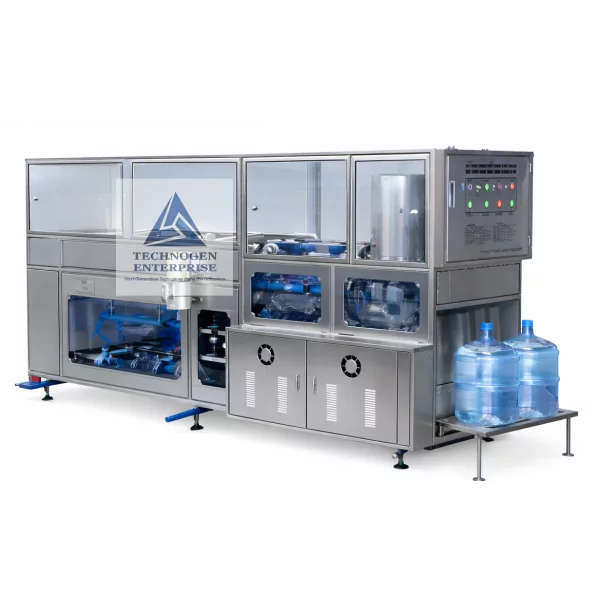
The Automatic Mineral Water 20 Liter Jar Rinsing Filling Capping Machine combines three-stage washing, water filling and automatic capping within one monoblock system.
Technogen Enterprise provides this machine as a Manufacturer and Supplier of 20 Liter Jar Rinsing Filling Capping Machine equipment for Tanzania, specifically for mineral-water packaging plants.
The machine delivers approximately 120 jars per hour for 20-litre containers. Loading and unloading of the jar are performed manually, while washing, filling and capping are integrated into the machine sequence.
Jar cleaning is carried out through three washing stages:
- Pure Water Wash
- Normal Recycled Water Wash
- Chlorine Wash
This allows the jar to pass through multiple cleaning media before entering the filling station.
The machine incorporates No Bottle–No Filling, No Bottle–No Rinsing and No Bottle–No Capping controls so that operations are linked to container presence.
After washing, the jar moves to the water-filling station.
Caps are handled automatically through a vibrator bowl, chute and capping-head unit.
The machine body uses PVC-coated AISI 304 construction, while contact parts are manufactured from AISI 316L Stainless Steel.
A special Stainless Steel slant conveyor is incorporated to reduce jar sticking during movement through the machine.
For Tanzania mineral-water producers packaging 20-litre jars, this configuration provides the main washing, filling and capping functions within one relatively compact production unit.
Working principle
- The operator manually loads an empty 20-litre jar into the machine.
- The jar enters the washing section.
- Three sequential cleaning stages are performed:
- Chlorine Wash
- Normal Recycled Water Wash
- Pure Water Wash
- After completion of washing, the jar moves towards the filling station.
- Container-presence logic ensures that filling does not occur when a jar is absent.
- The washed jar is filled with water at the filling station.
- Caps stored in the vibrator bowl are automatically oriented and transferred through the chute towards the capping unit.
- The capping head applies the cap to the filled jar.
- Once the rinsing, filling and capping operations are complete, the finished jar reaches the discharge position.
- Jar unloading is then performed manually.
Salient features
- GMP Model : Designed for organized mineral-water jar packaging operations.
- Compact Footprint : Combines multiple operations within one machine.
- Monoblock Construction : Integrates jar washing, filling and capping.
- Three-Stage Washing : Uses Chlorine Water, Recycled Water and Pure Water.
- AISI 304 Machine Body : Machine body uses PVC-coated Stainless Steel 304 construction.
- AISI 316L Contact Parts : Water-contact parts are manufactured from Stainless Steel 316L.
- No Bottle–No Rinsing : Prevents washing operation when a jar is absent.
- No Bottle–No Filling : Prevents water filling when no jar is present.
- No Bottle–No Capping : Prevents the capping cycle without a jar.
- SS Slant Conveyor : Helps reduce jar sticking during movement.
- Automatic Cap Feeding : Vibrator bowl stores and orients caps for automatic supply.
- Automatic Capping : Chute and capping-head arrangement complete cap application.
- CE-Certified Electronics : Electrical components are CE certified.
- Manual Jar Handling : Loading and unloading remain operator-controlled.
Safety & interlocks
- No Bottle–No Rinsing : Stops rinsing in the absence of a jar.
- No Bottle–No Filling : Stops water dispensing when no jar is positioned.
- No Bottle–No Capping : Prevents cap application without a jar.
Optional / add-on features
- Acrylic Safety Cabinet : Provides an enclosed machine operating area.
Applications & industries
The machine is designed specifically for 20-litre mineral-water jar packaging.
Its primary applications include:
- Mineral water bottling plants.
- Packaged drinking water plants using 20-litre jars.
- 20-litre jar washing.
- 20-litre jar filling.
- Automatic jar capping.
- Bulk drinking-water packaging.
The monoblock arrangement is particularly suitable where a plant requires a dedicated 20-litre jar line rather than adapting a conventional small-bottle RFC system.
For Tanzania water businesses supplying large household, office or institutional water containers, the machine provides a dedicated washing, filling and capping solution for the 20-litre format.
Application items
- 20-litre mineral water jar washing.
- 20-litre jar filling.
- 20-litre jar capping.
- Packaged drinking water production.
- Mineral water plant operation.
- Bulk water jar packaging.
- Three-stage jar washing.
- Large-container water filling.
Technical specifications
| Parameter | TGRFC-120JAM |
|---|---|
| Filling Speed | 120 Jars per Hour (20 Liter) |
| Design | Right to Left |
| Filling Range | 20 Liter |
| Jar Loading | Manual |
| Jar Unloading | Manual |
| Number of Stations | Washing, Filling, Capping |
| Washing Stages | 3 Stage (Pure Water, Recycled Water, Chlorine Wash) |
| Number of Pumps | 3 Nos |
| Power Consumption | 2 HP |
| Machine Construction | PVC Coated AISI 304, Contact Parts AISI 316L |
| Control Components | CE Certified |
| Machine Dimensions (L × W × H) | 2450 × 915 × 1900 mm |
| Operating Mode | Monoblock System |
Automatic Mineral Water 20 Liter Jar Rinsing Filling Capping Machine for Tanzania production
For manufacturers in Tanzania, Automatic Mineral Water 20 Liter Jar Rinsing Filling Capping Machine should be evaluated against the actual product, pack format, production schedule and operating environment. Monoblock 20-litre water jar packaging machine combining three-stage jar washing, water filling and automatic capping, with production capacity up to 120 jars per hour. The selected arrangement must suit both routine output and the changeovers expected during normal production.
Operating and product considerations
The dosing method is selected from the product behaviour and required fill range. Viscosity, density, foaming, suspended particles, powder flow or dosage form can influence the hopper, pump, auger, nozzle and container-handling arrangement. Product trials or representative samples reduce uncertainty before configuration.
Planning the complete production line
Tanzanian manufacturers should also define the container infeed, closure process, cleaning expectation and downstream labelling or secondary packaging. Reviewing these interfaces together helps establish a balanced line and prevents one machine from limiting the practical output of the complete process.
Information required for machine selection
- Product viscosity, density, foaming behaviour and suspended particles
- Minimum and maximum fill quantity with acceptable tolerance
- Container material, dimensions, neck opening and target output
Enquiries are supported for projects in Dar es Salaam, Dodoma, Mwanza, Arusha, Morogoro and other Tanzanian industrial locations. The final model, construction, output, documentation and support scope are confirmed in the commercial and technical offer.