Product overview
Not every liquid behaves well in a conventional syringe filler. Oils, honey, foamy beverages and liquids with changing viscosity can require a filling system that meters product by controlled pump rotation rather than mechanical syringe displacement.
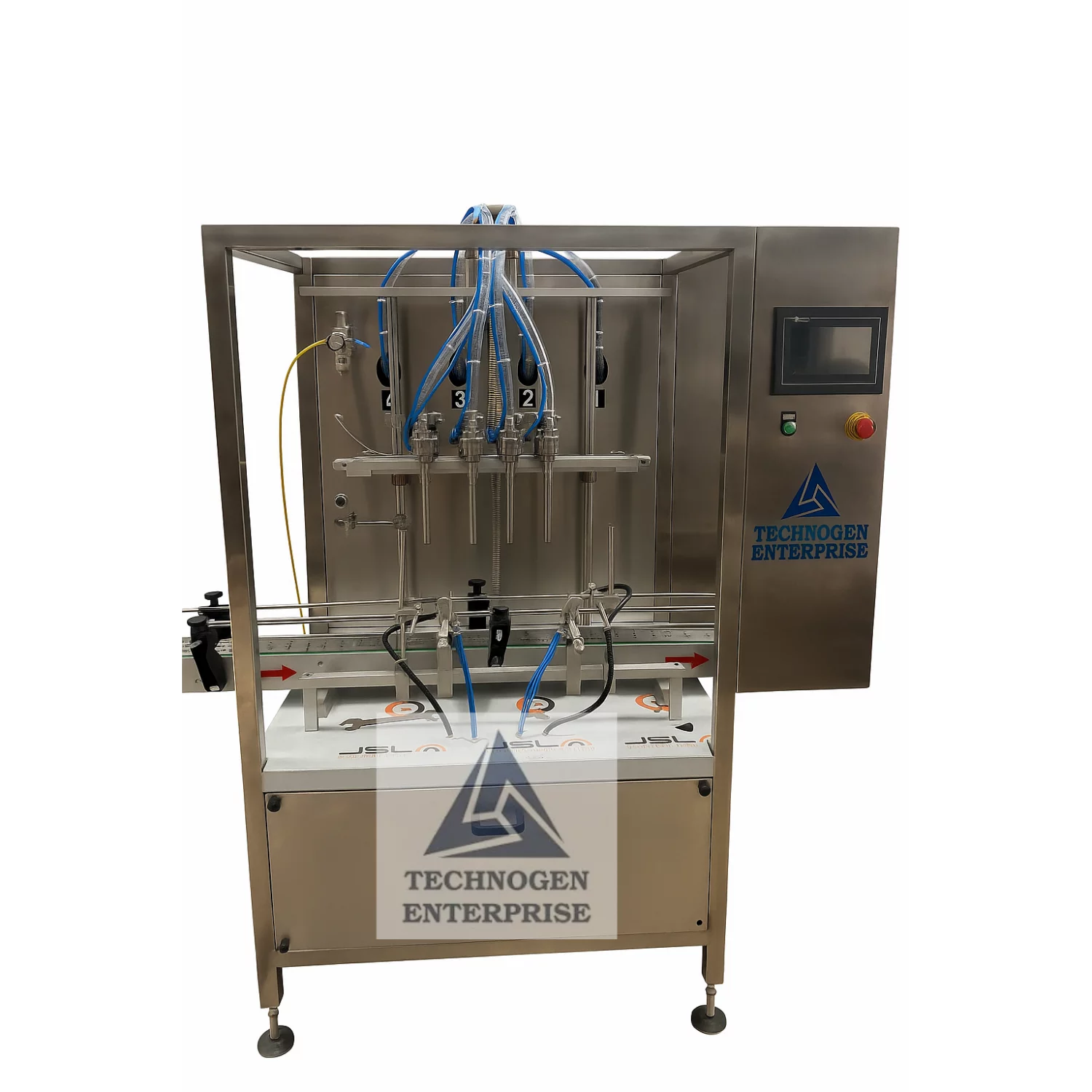
The Automatic Servo Driven Gear Pump Type Bottle Liquid Filling Machine addresses this requirement using an independent servo-driven gear pump for each filling head.
Technogen Enterprise is a Manufacturer and Supplier of Automatic Servo Driven Gear Pump Type Bottle Liquid Filling Machine systems for Tanzania, with 4, 6 and 8-head configurations designed for compatible round and flat bottles.
The fundamental dosing principle is straightforward: the amount of product delivered is controlled by the number of gear-pump revolutions commanded by the servo motor. Adjusting the servo rotation therefore changes the dispensed volume without relying on a conventional volumetric syringe mechanism.
Fill volume can be entered directly through the Human Machine Interface, making product setup more convenient when changing between recipes.
The machine is suitable for compatible conductive and non-conductive liquids, including products where foaminess or viscosity makes controlled filling important.
Applications specifically include oil, beverage and honey, allowing the platform to serve different liquid-processing industries.
Diving filling nozzles descend into the bottle during filling, helping reduce bubbling and foam formation. Pneumatic bottle stoppers hold containers in position during the filling cycle.
Each head incorporates its own servo-driven gear pump, enabling accurate metering while the PLC-HMI manages recipes, filling parameters and machine operation.
For manufacturers in Tanzania working with different liquid characteristics, this servo gear-pump approach provides a more electronically controlled alternative to traditional mechanically adjusted filling systems.
Working principle
Bottles travel from left to right through the conveyor towards the filling section.
Guide rails are adjusted without tools to accommodate compatible bottle formats.
Pneumatic bottle stoppers or the appropriate bottle-positioning arrangement hold the containers beneath the filling heads.
Each filling head is connected to its own servo-driven gear pump.
The PLC-HMI retrieves the selected filling recipe and determines the required servo-pump rotation for the programmed fill quantity.
As filling begins, the diving nozzles move into the bottle.
The servo motor rotates the gear pump through the required number of revolutions, delivering the programmed amount of liquid.
Because fill quantity is linked directly with controlled pump movement, the filling value can be changed through the HMI rather than through extensive mechanical adjustment.
The No Bottle–No Fill system prevents product discharge when a bottle is absent.
After filling, the nozzles withdraw, the bottle stoppers release and filled containers continue towards downstream packaging equipment.
Salient features
- CGMP Model : Designed for hygienic automatic liquid filling operations.
- Modular Construction : Allows filling-head configuration to match production capacity.
- Stainless Steel Machine Body : Provides durable industrial construction.
- AISI 316L / Silicone / PTFE Contact Parts : Provides suitable product-contact materials for compatible liquids.
- Independent Servo Gear Pumps : Each filling head has an individually controlled servo-pump arrangement.
- HMI Fill Volume Setting : Filling quantity can be adjusted directly from the operator interface.
- Recipe-Based Operation : Stores product-specific filling parameters for repeat production.
- Fill-Test Facility : Assists initial setup of new liquid recipes.
- No Bottle–No Fill System : Prevents unnecessary liquid discharge.
- Diving Nozzles : Helps reduce bubbling and foam during bottle filling.
- Toolless Guide Rails : Simplifies adjustment for different bottle formats.
- Pneumatic Bottle Stoppers : Hold containers securely during filling.
- Variable Speed Control : VFD provides overall machine speed adjustment.
- High-Precision Gear Pumps : Supports accurate metering and drip-resistant filling.
- Easy Cleaning & Changeover : Designed to simplify product and bottle changeover.
Safety & interlocks
- No Bottle–No Fill System : Prevents filling when no container is available at the filling position.
Optional / add-on features
- Safety Cabinet : Toughened Glass, Polycarbonate or Acrylic enclosure with door interlock.
- Turntable : Can be provided for bottle accumulation or feeding.
- 21 CFR Part 11 Capability : Available for regulated electronic-control applications.
Applications & industries
The servo gear-pump filling platform is particularly useful where liquid characteristics vary significantly between products.
Typical applications include:
Oils
Suitable for compatible edible, industrial or other oil-based liquid products.
Beverages
Can handle compatible beverage products, including liquids where controlled diving-nozzle filling helps manage foam.
Honey
Gear-pump metering makes the machine suitable for compatible higher-viscosity products such as honey.
Conductive & Non-Conductive Liquids
The filling principle does not depend on electrical conductivity of the liquid.
Foamy Liquids
Diving nozzles help control bubbling and foam development during filling.
Viscous Liquids
Servo-controlled gear pumps provide a practical metering method for compatible higher-viscosity products.
For manufacturers in Tanzania producing several liquid products, recipe-based control allows different filling parameters to be stored and recalled through the HMI.
Application items
- Oil bottle filling.
- Beverage bottle filling.
- Honey filling.
- Viscous liquid filling.
- Foamy liquid filling.
- Conductive liquid filling.
- Non-conductive liquid filling.
- Round bottle filling.
- Flat bottle filling.
- Servo-controlled liquid metering.
- Recipe-based automatic filling.
- High-precision gear-pump filling.
Technical specifications
| Parameter | TGLF-50SG | TGLF-80SG | TGLF-100SG |
|---|---|---|---|
| No of Filling Head | 4 HEAD | 6 HEAD | 8 head |
| Output | 40 to 50 Bottle per minute for 100 ml Filling | 80 to 90 Bottle per minute for 100 ml Filling | 100 to 110 Bottle per minute for 100 ml Filling |
| Power Consumption | 1.5 KW | 2 KW | 2.5 KW |
| Machine operating Direction | Left to Right | Left to Right | Left to Right |
| Filling technology | Servo Motor Based Metering | Servo Motor Based Metering | Servo Motor Based Metering |
| Filling Accuracy | ±2 % depending upon the liquid properties | ±2 % depending upon the liquid properties | ±2 % depending upon the liquid properties |
| Filling Range | 10 ml to 1000 ml | 10 ml to 1000 ml | 10 ml to 1000 ml |
| Bottle Diameter | 16 mm to 100 mm | 16 mm to 100 mm | 16 mm to 100 mm |
| Bottle Height | Up to 200 mm | Up to 200 mm | Up to 200 mm |
| Power requirement | 440v 3 Phase 50Hz 4 Wire System | 440v 3 Phase 50Hz 4 Wire System | 440v 3 Phase 50Hz 4 Wire System |
Machine video
Automatic Servo Driven Gear Pump Type Bottle Liquid Filling Machine — machine video 1
Automatic Servo Driven Gear Pump Type Bottle Liquid Filling Machine for Tanzania production
For manufacturers in Tanzania, Automatic Servo Driven Gear Pump Type Bottle Liquid Filling Machine should be evaluated against the actual product, pack format, production schedule and operating environment. Servo gear-pump liquid filler for accurate metering of oils, beverages, honey and other compatible conductive, non-conductive, foamy or viscous liquids, with independent servo control for each filling head. The selected arrangement must suit both routine output and the changeovers expected during normal production.
Operating and product considerations
The dosing method is selected from the product behaviour and required fill range. Viscosity, density, foaming, suspended particles, powder flow or dosage form can influence the hopper, pump, auger, nozzle and container-handling arrangement. Product trials or representative samples reduce uncertainty before configuration.
Planning the complete production line
Tanzanian manufacturers should also define the container infeed, closure process, cleaning expectation and downstream labelling or secondary packaging. Reviewing these interfaces together helps establish a balanced line and prevents one machine from limiting the practical output of the complete process.
Information required for machine selection
- Product viscosity, density, foaming behaviour and suspended particles
- Minimum and maximum fill quantity with acceptable tolerance
- Container material, dimensions, neck opening and target output
Enquiries are supported for projects in Dar es Salaam, Dodoma, Mwanza, Arusha, Morogoro and other Tanzanian industrial locations. The final model, construction, output, documentation and support scope are confirmed in the commercial and technical offer.