
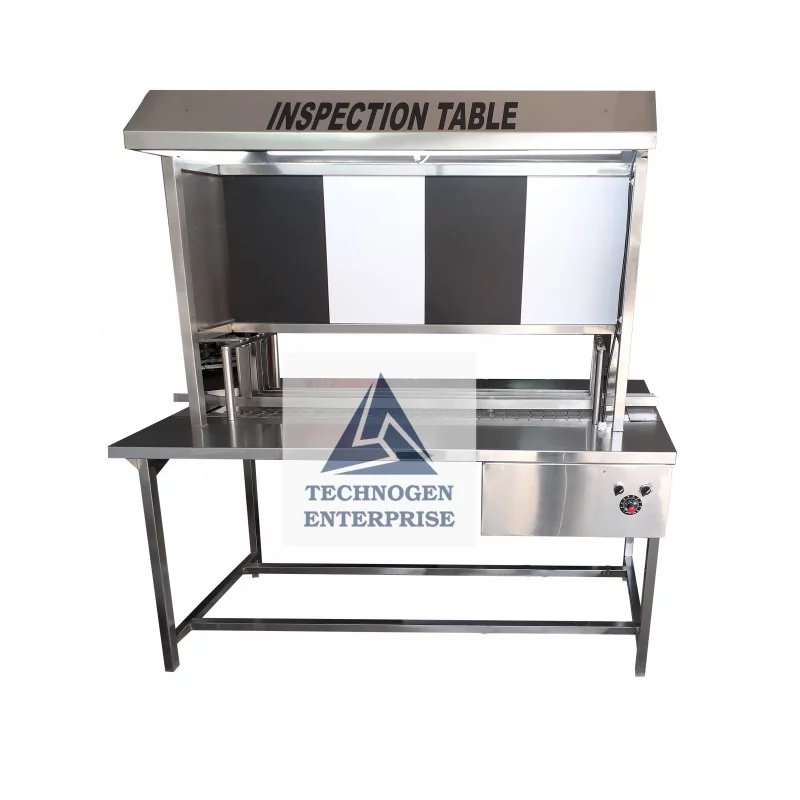
Product overview
Visual inspection becomes more effective when operators are given a stable product flow, proper illumination and contrasting backgrounds against which different types of visible contamination can be identified. The Manual Vial And Bottle Inspection Conveyor is designed around this operator-centered inspection method.
Technogen Enterprise offers the Manual Vial And Bottle Inspection Conveyor as a Manufacturer and Supplier for Tanzania, primarily for pharmaceutical and injectable manufacturing facilities that require human visual examination of filled vials and bottles before further processing.
The conveyor is arranged into three longitudinal sections. The central conveyor carries filled vials or bottles from the upstream machine through the inspection area, while the two side conveyors carry inspected containers forward after the operator completes the visual examination.
A black-and-white inspection board with suitable illumination creates contrasting viewing backgrounds. This arrangement helps operators observe visible impurities inside filled containers more clearly than inspection against a single background alone.
Instead of rotating or automatically rejecting the product, the machine is designed specifically for manual visual inspection with human intervention. The inspection decision therefore remains with trained operators positioned along the conveyor.
Different machine lengths are available according to the required number of inspection stations. Configurations are provided for 2, 4, 6, 8 or 10 operators, allowing inspection capacity to be matched with production-line requirements.
Another practical advantage is format flexibility. No dedicated format parts are required when changing between compatible vial or bottle sizes, reducing setup work when multiple container formats are inspected on the same line.
For pharmaceutical and injectable facilities in Tanzania, the conveyor provides a straightforward way to organize manual inspection as a defined production-line stage rather than relying on separate handling tables or disconnected inspection stations.
Working principle
Filled vials or bottles arrive from the upstream production equipment and enter the central section of the inspection conveyor.
As containers travel through the inspection area, operators seated along the conveyor manually pick or observe the containers against the illuminated viewing arrangement.
The inspection station uses both white and black backgrounds, allowing the operator to change visual contrast depending on the type and appearance of the impurity being checked.
After inspection, accepted containers are transferred to the side conveyor sections for onward movement towards the next downstream operation.
The three-part conveyor arrangement therefore separates:
Incoming Products : Central conveyor carries vials and bottles into the inspection area.
Inspection Activity : Operators visually examine each container against the illuminated black-and-white background.
Inspected Products : Side conveyors transport checked containers towards downstream processing.
The system relies on human inspection rather than automatic camera-based evaluation, making operator training and inspection discipline important parts of the process.
Salient features
- CGMP Model : Designed for organized pharmaceutical inspection operations.
- Modular Construction : Allows machine length and operator capacity to vary by configuration.
- Black-and-White Inspection Board : Provides contrasting backgrounds for identifying visible impurities.
- Illuminated Viewing Area : Supports clear visual examination of filled containers.
- Stainless Steel Construction : Provides durable construction suitable for pharmaceutical environments.
- Three-Section Conveyor Layout : Separates incoming inspection flow from checked product transfer.
- Multiple Operator Configurations : Available for 2, 4, 6, 8 or 10 inspection positions.
- No Format Parts : Compatible vial and bottle size changes do not require dedicated change parts.
- Simple Operation : Keeps the inspection process centered on trained human operators.
- Low Maintenance Design : Designed for straightforward routine operation.
Applications & industries
The Manual Vial And Bottle Inspection Conveyor is intended for pharmaceutical and injectable manufacturing plants where filled containers require manual visual inspection before further processing.
It is suitable for:
- Filled pharmaceutical vials.
- Injectable product vials.
- Filled pharmaceutical bottles.
- Bottle and vial quality-control inspection.
- Manual inspection of visible impurities.
- Production lines requiring operator-based inspection.
The illuminated black-and-white background helps provide visual contrast when checking filled containers for visible contamination or abnormalities.
For Tanzania pharmaceutical operations, the machine can be selected according to the number of operators required, with configurations ranging from 2 inspection seats to 10 inspection seats.
Application items
- Pharmaceutical vial inspection.
- Injectable vial visual inspection.
- Filled bottle visual inspection.
- Manual impurity inspection.
- Pharmaceutical quality-control inspection.
- Human visual inspection of filled containers.
- Black-background container inspection.
- White-background container inspection.
- Multi-operator vial inspection.
- Production-line bottle inspection.
Technical specifications
| Parameter | TGVIC-60 | TGVIC-100 | TGVIC-150 | TGVIC-200 | TGVIC-250 |
|---|---|---|---|---|---|
| Seating Arrangement for operator | 2 | 4 | 6 | 8 | 10 |
| Power Consumption | 0.5 HP | 0.5 HP | 0.75 HP | 0.75 HP | 1 HP |
| Dimension (L X W X H) mm | 1300 x 765 x 1530 | 1900 x 765 x 1530 | 2550 x 765 x 1530 | 3100 x 765 x 1530 | 3700 x 765 x 1530 |
| Direction | Left to Right | Left to Right | Left to Right | Left to Right | Left to Right |
| Electrical connection | 415 Volts, 3 Phase (4wire system)50 Hz. | 415 Volts, 3 Phase (4wire system)50 Hz. | 415 Volts, 3 Phase (4wire system)50 Hz. | 415 Volts, 3 Phase (4wire system)50 Hz. | 415 Volts, 3 Phase (4wire system)50 Hz. |
Product gallery
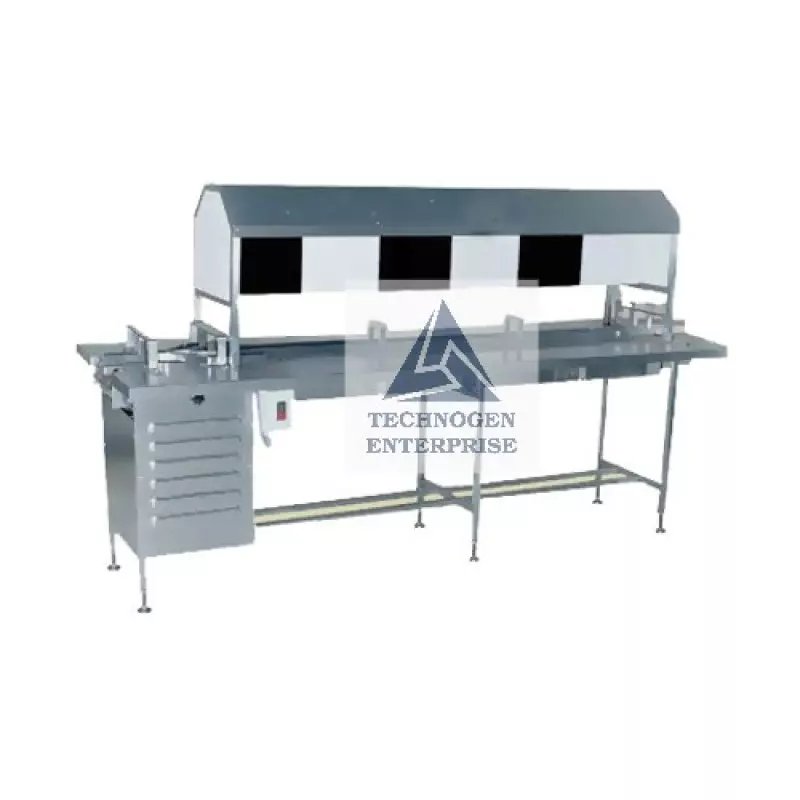
Manual Vial And Bottle Inspection Conveyor for Tanzania production
For manufacturers in Tanzania, Manual Vial And Bottle Inspection Conveyor should be evaluated against the actual product, pack format, production schedule and operating environment. Operator-assisted pharmaceutical inspection conveyor with illuminated black-and-white viewing backgrounds and a three-section conveyor arrangement for visual examination of filled vials and bottles before downstream processing in Tanzania. The selected arrangement must suit both routine output and the changeovers expected during normal production.
Operating and product considerations
Inspection performance is defined by the pack, defect or weight condition to be identified, line speed and rejection or operator-review method. Representative production samples are required to set a realistic inspection scope and confirm how the machine will handle accepted and rejected packs.
Planning the complete production line
For Tanzania production lines, the inspection point should be positioned where it can verify the relevant process without disrupting product flow. Conveyor height, pack spacing, data requirements and the method for collecting rejected products should be agreed during layout review.
Information required for machine selection
- Actual product and packaging samples or drawings
- Required output and operating schedule
- Available electrical, compressed-air, water or steam utilities
Enquiries are supported for projects in Dar es Salaam, Dodoma, Mwanza, Arusha, Morogoro and other Tanzanian industrial locations. The final model, construction, output, documentation and support scope are confirmed in the commercial and technical offer.