Product overview
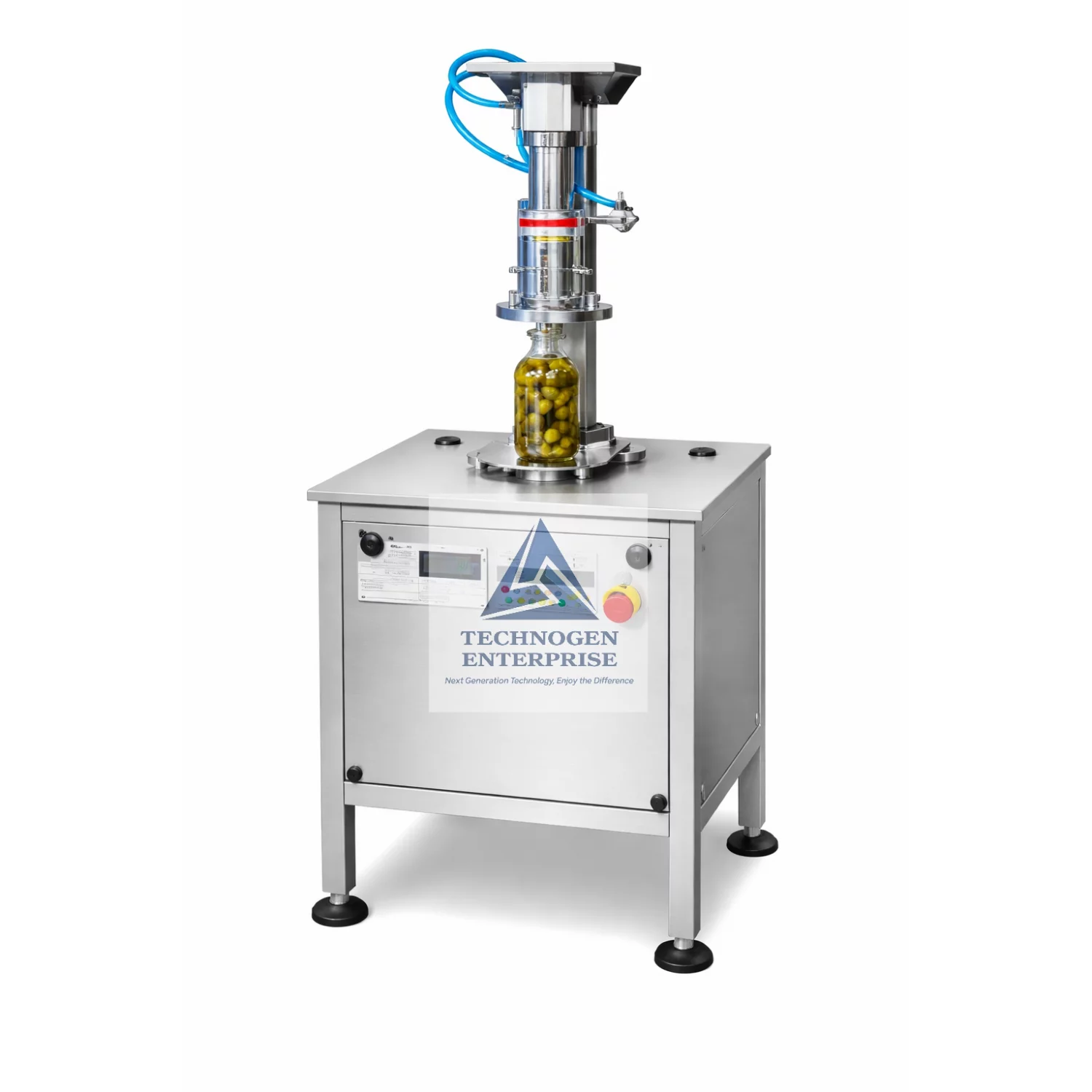
For manufacturers that require reliable lug-cap tightening without a fully automatic conveyor line, the Semi Automatic Lug Capping Machine offers a compact and practical solution for low to medium-volume packaging.
Technogen Enterprise is a Manufacturer and Supplier of Semi Automatic Lug Capping Machine solutions for Tanzania, serving food, dairy, milk, vinegar, pickle and allied packaging applications where controlled lug-cap torque is required.
The machine follows the same proven lug-capping principle as the automatic single-head version but is configured for manual bottle loading and manual cap placement. It does not incorporate an automatic conveyor or cap-feeding system, making it suitable for production environments where operators handle container positioning and cap loading directly.
The machine uses a single pneumatic-mechanical magnetic hysteresis clutch-based lug capping head. This arrangement provides torque control during the capping cycle, helping achieve uniform and repeatable closure tightening.
It can handle bottles from 22 mm to 100 mm diameter, bottle heights from 15 mm to 100 mm, and lug caps from 22 mm to 84 mm diameter.
The semi-automatic configuration makes the equipment particularly suitable for start-up manufacturers, specialty food producers, smaller packaging units and operations in Tanzania where production volume does not justify an automatic conveyor-based capping system.
With a compact Stainless Steel construction, simple operation and reduced machine complexity, the unit provides a cost-effective route to consistent lug-cap application while retaining the key torque-control technology of the automatic machine.
Working principle
The Semi Automatic Lug Capping Machine operates through manual bottle and cap loading combined with a powered single-head capping process.
The operator manually places the bottle in the capping position.
A compatible lug cap is then manually positioned on the bottle mouth.
Once the bottle and cap are correctly located, the pneumatic-mechanical magnetic hysteresis clutch-based capping head engages the lug cap and performs the tightening cycle.
Torque can be adjusted through the capping-head arrangement according to the cap and container requirement, helping provide consistent tightening from one bottle to the next.
After completion of the capping cycle, the operator removes the capped bottle and places the next bottle into position.
Because bottle feeding, cap placement and bottle removal are performed manually, production output depends on operator efficiency, bottle size and lug-cap size.
The absence of a conveyor and automatic cap feeder keeps the machine compact and makes it appropriate for smaller production areas and lower-volume operations.
Salient features
- Compact Design : Suitable for low and medium-volume packaging operations.
- Semi Automatic Operation : Combines manual bottle handling with powered lug capping.
- Manual Bottle Loading : Operator positions each bottle for the capping cycle.
- Manual Cap Placement : Lug caps are placed manually before capping.
- Stainless Steel Contact Parts : Bottle and lug-cap contact parts use quality Stainless Steel.
- Magnetic Hysteresis Capping Head : Provides controlled lug-cap tightening.
- Pneumatic Capping System : Supports consistent single-head capping operation.
- Adjustable Torque : Allows tightening torque to be set according to the closure.
- Single Head Operation : Provides controlled capping of one bottle per cycle.
- Fast Bottle Changeover : Supports easy handling of compatible bottle sizes.
- Simple Operating Concept : Suitable for start-up and smaller production units.
Applications & industries
The Semi Automatic Lug Capping Machine is suitable for food, dairy, milk, vinegar, pickle and allied packaging industries requiring controlled lug-cap tightening without a fully automatic bottle-handling line.Application items
- Food jar lug capping.
- Dairy product container capping.
- Milk container lug capping.
- Vinegar bottle capping.
- Pickle jar lug capping.
Technical specifications
| Parameter | TGLC-30S |
|---|---|
| Feeding Technology | Bottle and Cap Feeding – Manual |
| Output Capacity | 20 Containers per Minute (Depends on Human Efficiency) |
| Number of Sealing Heads | 1 No. |
| Lug Capping Diameter Range | 18 mm to 90 mm |
| Bottle Diameter Range | 22 mm to 100 mm |
| Bottle Height Range | 58 mm to 240 mm |
| Electrical Motor | 1 HP / 440 V / 3 Phase / 50 Hz (Four Wire) |
| Power Consumption | 1 kW |
| Electrical Supply | 230 V – Single Phase – 50 Hz |
| Overall Dimensions (L × W × H) | 1000 × 720 × 1400 mm (Approx.) |
| Net Weight | 200 kg (Approx.) |
| Gross Weight | 350 kg (Approx.) |
| Change Parts Required | Lug Capping Head (If Lug Cap Size Changes) |
Semi Automatic Lug Capping Machine for Tanzania production
For manufacturers in Tanzania, Semi Automatic Lug Capping Machine should be evaluated against the actual product, pack format, production schedule and operating environment. Compact semi-automatic lug capping machine for controlled closure of bottles and jars, using manual bottle and cap loading with a torque-adjustable magnetic hysteresis capping head for Tanzania production units. The selected arrangement must suit both routine output and the changeovers expected during normal production.
Operating and product considerations
Closure quality depends on the relationship between the bottle neck, cap geometry, feeding method and tightening or crimping action. Samples are used to confirm container support, cap presentation and the correct head or tooling so that closures are applied consistently without avoidable bottle damage or line stoppages.
Planning the complete production line
A complete Tanzanian packaging line may connect this capper with bottle feeding, liquid or powder filling, induction or foil sealing, labelling, coding and accumulation. The upstream delivery rate, conveyor height, container stability and downstream inspection requirement should be reviewed together before the final layout is approved.
Information required for machine selection
- Bottle and closure samples with dimensional drawings
- Closure application method, torque or crimping requirement
- Cap feeding, container stability and upstream line speed
Enquiries are supported for projects in Dar es Salaam, Dodoma, Mwanza, Arusha, Morogoro and other Tanzanian industrial locations. The final model, construction, output, documentation and support scope are confirmed in the commercial and technical offer.