Product overview
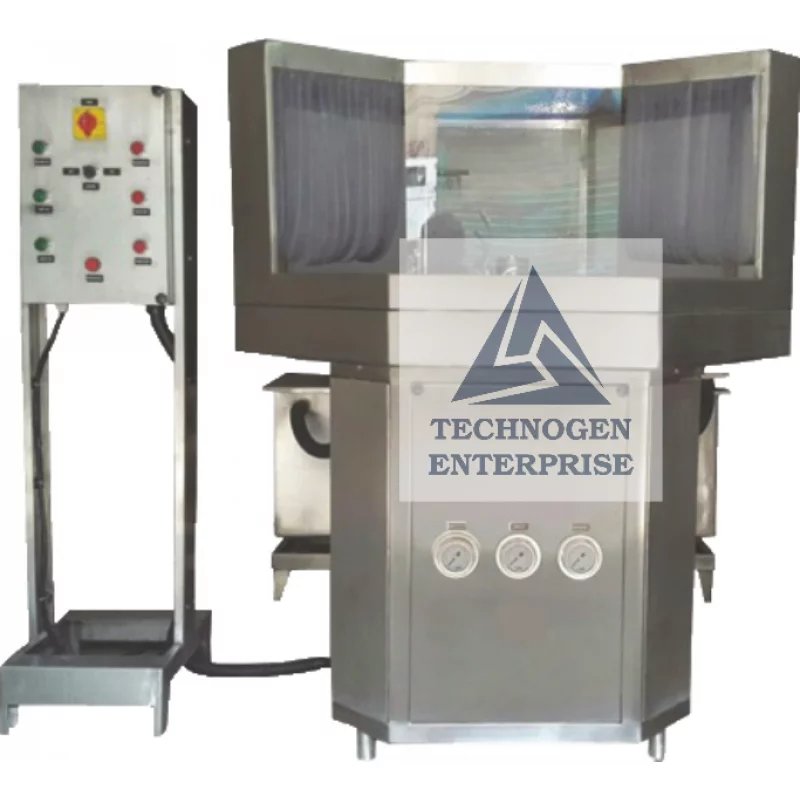
When production volumes do not justify a fully automatic bottle washer, the priority shifts to achieving reliable internal and external cleaning without adding unnecessary line complexity. The Semi Automatic Rotary Bottle Washing Machine is built for exactly this requirement.
Its rotary intermittent-motion design uses a Geneva indexing mechanism to move bottles through successive washing stations. The operator manually loads bottles into the machine pockets and removes them after completion of the washing cycle, making the system well suited to production environments where moderate output and controlled washing are more important than complete automation.
Technogen Enterprise is a Manufacturer and Supplier of Semi Automatic Rotary Bottle Washing Machine equipment for Tanzania, offering a compact solution for washing compatible Glass and Plastic bottles.
The washing arrangement combines four internal washes, one external wash and one air wash. Fresh Water, Hot Detergent and DM or DI Water can be used in a defined sequence, while the actual washing program can also be customized to suit process requirements.
High-pressure spraying nozzles direct the washing medium into the bottle, while stationary nozzle construction helps avoid cross-contamination between washing cycles and reduces the possibility of bottle-neck chipping during washing.
The machine can handle both round and flat bottles, with bottle diameters from 24 mm to 100 mm, neck diameters from 20 mm to 40 mm, and heights up to 290 mm.
Production output ranges from approximately 60 to 100 bottles per minute, depending largely on operator loading and unloading efficiency.
For manufacturers in Tanzania requiring a compact bottle-cleaning system before filling or downstream packaging, this semi-automatic rotary design provides a practical balance between controlled washing and manual handling.
Working principle
The operator manually places bottles into two rows of machine pockets.
The Geneva drive indexes the bottles intermittently from one washing station to the next.
At each station, a dedicated solenoid valve controls the required washing medium.
The standard washing sequence is arranged as follows:
| Washing Medium | Sequence |
|---|---|
| Fresh Water | First Wash |
| Hot Detergent | Second Wash |
| Fresh Water | Third Wash |
| DM / DI Water | Fourth Wash |
| Fresh Water | External Wash |
| Air | Final Air Wash |
During the internal washing stages, stationary high-pressure nozzles spray the selected medium inside the inverted or positioned bottle.
An additional external washing station cleans the outside surface.
The final air wash assists in removing residual washing medium from the bottle.
After completing the full washing sequence, the bottles return to the unloading position where they are manually removed by the operator.
The sequence can be modified according to the required process, and a water recycling arrangement can also be incorporated where required.
Salient features
- Geneva Indexing System : Provides intermittent rotary movement between washing stations.
- Round & Flat Bottle Handling : Suitable for different compatible bottle shapes.
- Four Internal Washes : Provides multiple internal cleaning stages.
- External Bottle Wash : Adds a dedicated outside washing cycle.
- Air Wash : Provides a final air-cleaning stage after liquid washing.
- Customized Washing Sequence : Washing order can be configured according to process requirements.
- Stationary Nozzles : Helps prevent mixing between washing cycles and reduces bottle-neck chipping.
- High-Pressure Spray Nozzles : Provides effective internal bottle washing.
- Two-Row Manual Loading : Simplifies operator loading and unloading.
- Individual Solenoid Valves : Controls each washing sequence independently.
- High-Capacity Centrifugal Pumps : Supports washing of larger compatible bottles.
- Portable Pump & Tank Stand : Simplifies cleaning and maintenance access.
- Water Recycling Provision : Recycling arrangement can be incorporated according to requirement.
Safety & interlocks
- Emergency stop - Machine stop
Applications & industries
The Semi Automatic Rotary Bottle Washing Machine is intended for production areas where Glass and Plastic bottles require controlled internal and external washing before further processing.
It is particularly suitable where:
- Production requirements are comparatively moderate.
- Manual bottle loading and unloading are acceptable.
- Both internal and external bottle washing are required.
- Multiple washing media need to be used in sequence.
- Round and flat bottles must be processed on the same equipment.
- Different washing sequences are required for different products.
For Tanzania production facilities that do not require a fully automatic linear washer, this rotary machine provides a compact and flexible bottle-cleaning alternative.
Application items
- Glass bottle washing.
- Plastic bottle washing.
- Round bottle washing.
- Flat bottle washing.
- Internal bottle washing.
- External bottle washing.
- Fresh-water bottle washing.
- Hot-detergent bottle washing.
- DM-water bottle washing.
- DI-water bottle washing.
- Air washing of bottles.
- Lower-output bottle cleaning operations.
Technical specifications
| Parameter | TGBW-100S |
|---|---|
| Diameter of Bottle | 24 mm to 100 mm |
| Neck Diameter of Bottle | 20 mm to 40 mm |
| Output | 60 to 100 bottle per minute depending upon the human efficiency |
| Height of Bottle | Up to 290 mm |
| Motor for main drive | 1/2 HP / 415 V/3 Phase / 50 Hz /1000 RPM |
| Electric Heater Tank | 3 KW |
| Power Requirement | 5 KW |
| Dimensions | 1650 mm L X 1600 mm W X 1300 mm H |
Semi Automatic Rotary Bottle Washing Machine for Tanzania production
For manufacturers in Tanzania, Semi Automatic Rotary Bottle Washing Machine should be evaluated against the actual product, pack format, production schedule and operating environment. Compact rotary bottle washer for internal and external cleaning of glass and plastic bottles, using multiple water and air washing cycles with manual bottle loading and unloading for lower-output production. The selected arrangement must suit both routine output and the changeovers expected during normal production.
Operating and product considerations
Container preparation is defined by the bottle, vial or ampoule material, dimensions, contamination risk and required washing sequence. The handling parts, rinse stages, air treatment and drainage arrangement must be compatible with the container and the cleanliness objective of the production process.
Planning the complete production line
The washer is normally assessed with the downstream filling operation, available treated-water supply, compressed air, drainage and room layout. Tanzania projects should confirm utilities and container transfer early because these inputs influence both equipment configuration and the surrounding facility plan.
Information required for machine selection
- Container drawing and material
- Required internal and external wash sequence
- Water, air and drainage utilities with downstream interface
Enquiries are supported for projects in Dar es Salaam, Dodoma, Mwanza, Arusha, Morogoro and other Tanzanian industrial locations. The final model, construction, output, documentation and support scope are confirmed in the commercial and technical offer.