Product overview
Pre-cut paper labels remain a practical packaging choice when pressure-sensitive label rolls are not required. For moderate production volumes, a fully automatic wet-glue line may also add more automation than the operation actually needs.
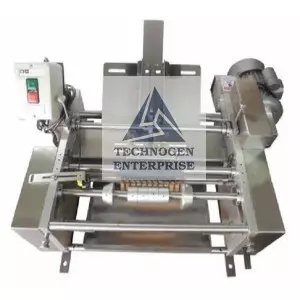
The Semi Automatic Wet Glue Labeling Machine provides a simpler approach by combining manual bottle handling with machine-controlled cold-glue label application.
Technogen Enterprise is a Manufacturer and Supplier of Semi Automatic Wet Glue Labeling Machine equipment for Tanzania, intended for manufacturers requiring economical pre-cut label application at moderate production rates. Pasted markdown(9)
The machine can label up to approximately 40 containers per minute, depending upon operator efficiency.
It is suitable for containers manufactured from Glass, Plastic, PET, Composite, Aluminium, HDPE and LDPE, as well as compatible bottles, tins and jars. The machine can also accommodate grooved and Brut-shaped bottles. Pasted markdown(9)
A specially designed strip gluing system minimizes glue consumption, while the electronic label-pickup arrangement manages the pre-cut labels.
The machine supports partial labeling as well as complete or overlapped labeling.
No dedicated change parts are required when changing compatible container or label sizes, and normal bottle/label changeover is specified at approximately 5–10 minutes.
Its compact 715 × 715 × 460 mm dimensions make the machine practical for Tanzania businesses with limited production space or smaller packaging batches.
Working principle
- Pre-cut labels are loaded into the machine's label magazine.
- The operator manually places the container into the labeling position.
- The electronic label-pickup system selects the required label.
- Cold glue is applied through the strip-gluing arrangement.
- The prepared label is transferred onto the container surface.
- Depending on the selected application, the label can be applied as a partial label or as a complete/overlapped label.
- The operator then removes the labeled container and places the next container into the machine.
- The No Container–No Label system prevents label application when a container is absent.
Salient features
- CGMP Model : Designed for controlled industrial labeling operations.
- Compact Construction : Suitable for limited production-floor space.
- Semi Automatic Operation : Combines operator bottle handling with machine label application.
- Cold Glue Labeling : Applies pre-cut labels using wet-glue technology.
- Low-Cost Labeling System : Intended for economical moderate-volume production.
- No Container–No Label : Prevents label application without a container.
- No Format Change Parts : Compatible container and label-size changes do not require dedicated parts.
- Electronic Label Pickup : Controls handling of pre-cut labels.
- Strip Gluing System : Minimizes cold-glue consumption.
- Multi-Material Compatibility : Handles Glass, Plastic, PET, Composite, Aluminium, HDPE and LDPE containers.
- Multiple Container Types : Suitable for bottles, tins and jars.
- Special Bottle Shapes : Can handle compatible grooved and Brut-shaped bottles.
- Partial Labeling : Supports labels covering part of the container circumference.
- Overlap Labeling : Supports complete or overlapped label application.
- SS 304 Structure : Machine frame is manufactured using Stainless Steel 304.
- Heavy-Duty Drive : Uses heavy-duty gearbox and motor construction.
Optional / add-on features
- Large Label Version : Available for labels up to 220 mm wide and 525 mm long.
- Customized Machine Size : Special configurations can be produced according to required container and label dimensions.
Applications & industries
The Semi Automatic Wet Glue Labeling Machine is designed for pre-cut paper label application using cold glue.
Suitable containers include:
- Glass bottles.
- Plastic bottles.
- PET bottles.
- Composite containers.
- Aluminium bottles or containers.
- HDPE bottles.
- LDPE bottles.
- Tins.
- Jars.
- Grooved bottles.
- Brut-shaped bottles.
It is particularly suitable for moderate-volume Tanzania production where operator loading is acceptable and an economical wet-glue labeling method is preferred.
Application items
- Pre-cut paper labeling.
- Cold-glue bottle labeling.
- Glass bottle labeling.
- PET bottle labeling.
- Plastic bottle labeling.
- HDPE bottle labeling.
- LDPE bottle labeling.
- Aluminium container labeling.
- Jar labeling.
- Tin labeling.
- Partial labeling.
- Overlap labeling.
Technical specifications
| Parameter | TGSW-30S |
|---|---|
| Automation Grade | Semi Automatic |
| Container Diameter | 40 mm to 150 mm* |
| Height of Container | 35 mm to 260 mm* |
| Label Width | 25 mm to 160 mm* |
| Label Length | 90 mm to 325 mm* |
| Electrical Connection | 440V- 3 Phase - 50 Hz |
| Power Requirement | 0.25 H.P. |
| Labeling Speed (Bottle/ Minute) | Up to 40 Labels per minute (Depending on skill of operator) |
| Bottle & Label Change Over Time | 5 to 10 Minutes |
| Label Magazine Capacity | 200 Labels Appx. |
| Overall Dimensions | 715 mm (L) x 715 mm (W) x 460 mm (H) |
Semi Automatic Wet Glue Labeling Machine for Tanzania production
For manufacturers in Tanzania, Semi Automatic Wet Glue Labeling Machine should be evaluated against the actual product, pack format, production schedule and operating environment. Compact semi-automatic labeling machine for applying pre-cut paper labels with cold glue to bottles, tins and jars, with manual container handling and output up to 40 labels per minute. The selected arrangement must suit both routine output and the changeovers expected during normal production.
Operating and product considerations
Reliable label placement begins with the container shape, surface, label stock, backing paper, adhesive and required application position. Product samples help define guides, sensors, dispensing geometry and pressing devices while also confirming how quickly an operator can change between supported formats.
Planning the complete production line
For a Tanzania packaging project, the labeller should be planned with the conveyor, upstream filling or capping machine and any batch-coding or inspection system. Container spacing and orientation affect placement consistency, so the proposal should consider the whole transfer sequence rather than the label head alone.
Information required for machine selection
- Container shape and dimensional range
- Label material, backing, dimensions and required application position
- Coding requirement, output and upstream product spacing
Enquiries are supported for projects in Dar es Salaam, Dodoma, Mwanza, Arusha, Morogoro and other Tanzanian industrial locations. The final model, construction, output, documentation and support scope are confirmed in the commercial and technical offer.